Problem
MOOC platforms lose learners who can't find their next course. The goal: recommend each learner's next course from their history — and prove the recommender actually beats simpler alternatives before anyone trusts it.
Approach
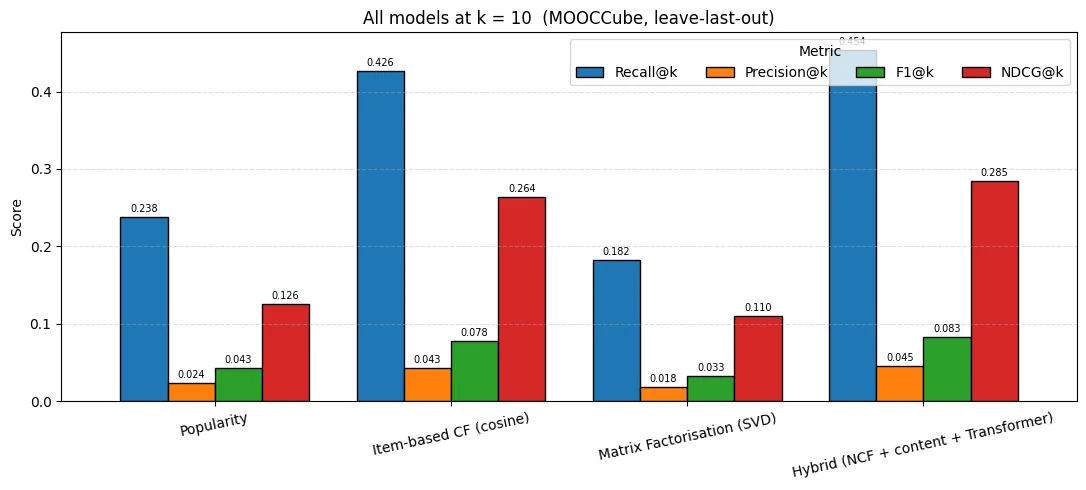
Instead of jumping straight to deep learning, the project built an honest evaluation harness first: a chronological leave-last-out split (predict each learner's final enrollment from everything before it), shared by every model. Three baselines — popularity, item-based collaborative filtering, and matrix factorization (SVD) — set the bar. The hybrid model then had to clear it.
Technology
- PyTorch — Transformer/GRU sequence encoder over each learner's enrollment history
- sentence-transformers (all-MiniLM-L6-v2) — content embeddings of course titles (translated zh→en with Argos)
- Collaborative signals — item-item similarity fused with the learned representations
- Flask REST API —
/recommend,/health, and sample-user endpoints over precomputed top-20 lists
Implementation
The pipeline downloads and k-core filters MOOCCube, trains the hybrid network with AdamW, and runs ablations to show each component earns its place. Cold-start slices measure how the model behaves for learners with almost no history — where content embeddings carry the load. Significance testing (p ≈ 1e-182) confirms the improvement isn't noise.
Result
The hybrid model beat every baseline on every metric: Recall@10 rose to 0.454 from item-CF's 0.426, NDCG@10 to 0.285 from 0.264, and AUC to 0.9279 from 0.9188. Recommendations for all 95,415 learners are precomputed and served through the Flask API with a browser demo UI.
Need a similar system?
Describe your data and the decision it should support — you'll get a feasibility answer and a fixed quote.
Start a project →