Problem
In wind energy, a missed generator failure means an expensive replacement; a false alarm only costs an inspection. The business asymmetry defines the ML goal: maximize recall on failures (about 5.5% of readings) without flooding the maintenance team with false positives.
Approach
Seven feed-forward network configurations were trained and compared under the same preprocessing (median imputation + standardization fitted only on training data): SGD vs Adam optimizers, deeper stacks, dropout regularization, class weighting, and their combinations. Model selection used validation recall, not accuracy — accuracy is nearly meaningless at 5.5% prevalence.
Technology
- TensorFlow / Keras Sequential networks with ReLU hidden layers
- Class weights to price a missed failure higher than a false alarm
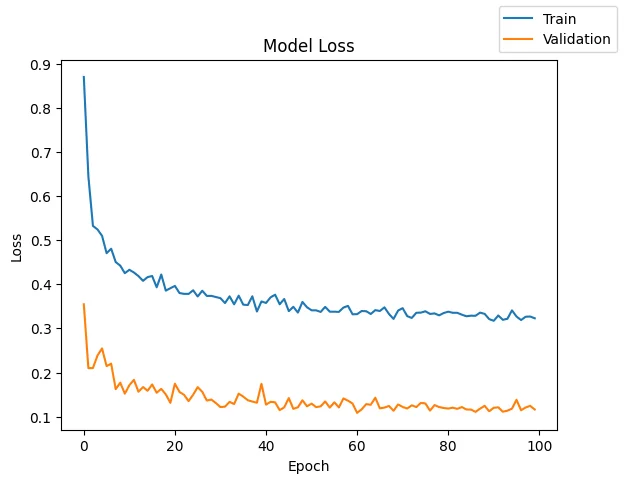
- Dropout (50%) to control the overfitting visible in unregularized runs
- scikit-learn preprocessing and evaluation metrics
Result
The selected configuration (two hidden layers + 50% dropout + class weights) generalized cleanly: on 5,000 unseen test readings it reached recall 0.936, precision 0.964, F1 0.950, and accuracy 0.9896 at the tuned operating point. In plain terms: roughly 94 of every 100 real failures are caught early, and when the model raises an alarm it is right about 96% of the time.
Need a similar system?
Describe your data and the decision it should support — you'll get a feasibility answer and a fixed quote.
Start a project →