Problem
The Global Assessment of Functioning (GAF) score summarizes how well a psychiatric patient functions day-to-day. Across 10,000 patient records: which clinical and demographic factors actually predict functioning — and which widely-assumed ones don't?
Approach
Random-forest feature screening narrowed the field, then classical statistics did the careful work: Pearson correlations, t-tests and Mann-Whitney for group differences, ANOVA and chi-square for categorical structure, and an OLS regression as the interpretable summary model. Every headline finding is backed by a test statistic, not a gradient.
Result
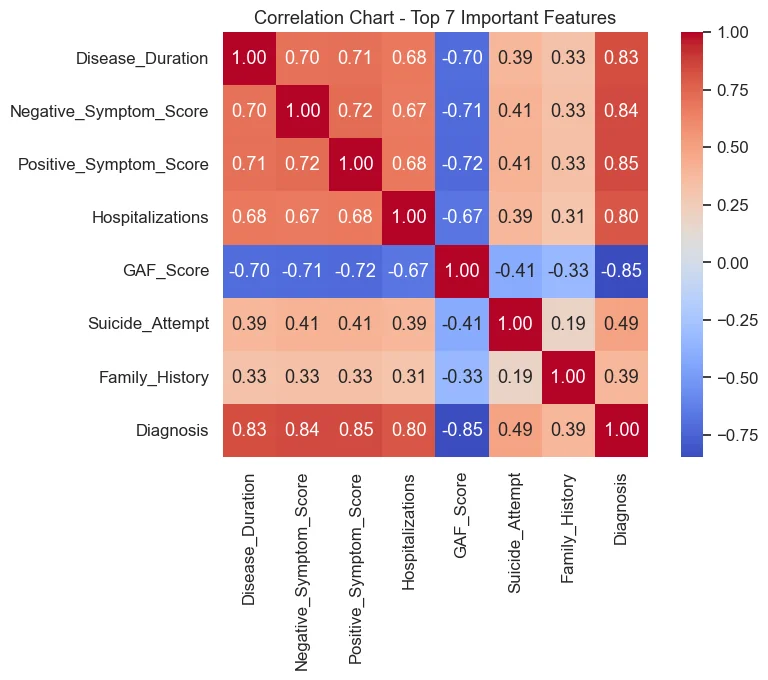
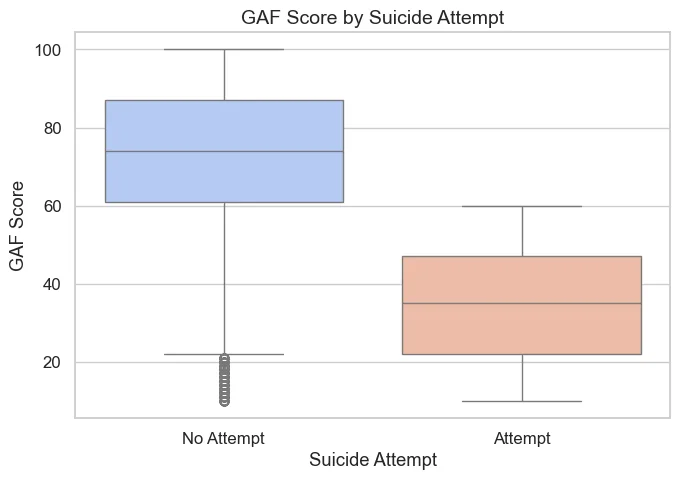
Clinical variables dominate: disease duration and symptom scores correlate with GAF at roughly −0.70 to −0.72, and the OLS model explains 63% of variance (R² 0.630) with both symptom coefficients significant at p < 0.001. Patients with a suicide-attempt history score dramatically lower (~20–40 vs ~60–80, p < 0.0001). Demographics, by contrast, are largely irrelevant — gender's p-value is 0.84. For a clinical audience the message is actionable: functioning tracks the disease, not the demographic file.
Need a similar system?
Describe your data and the decision it should support — you'll get a feasibility answer and a fixed quote.
Start a project →